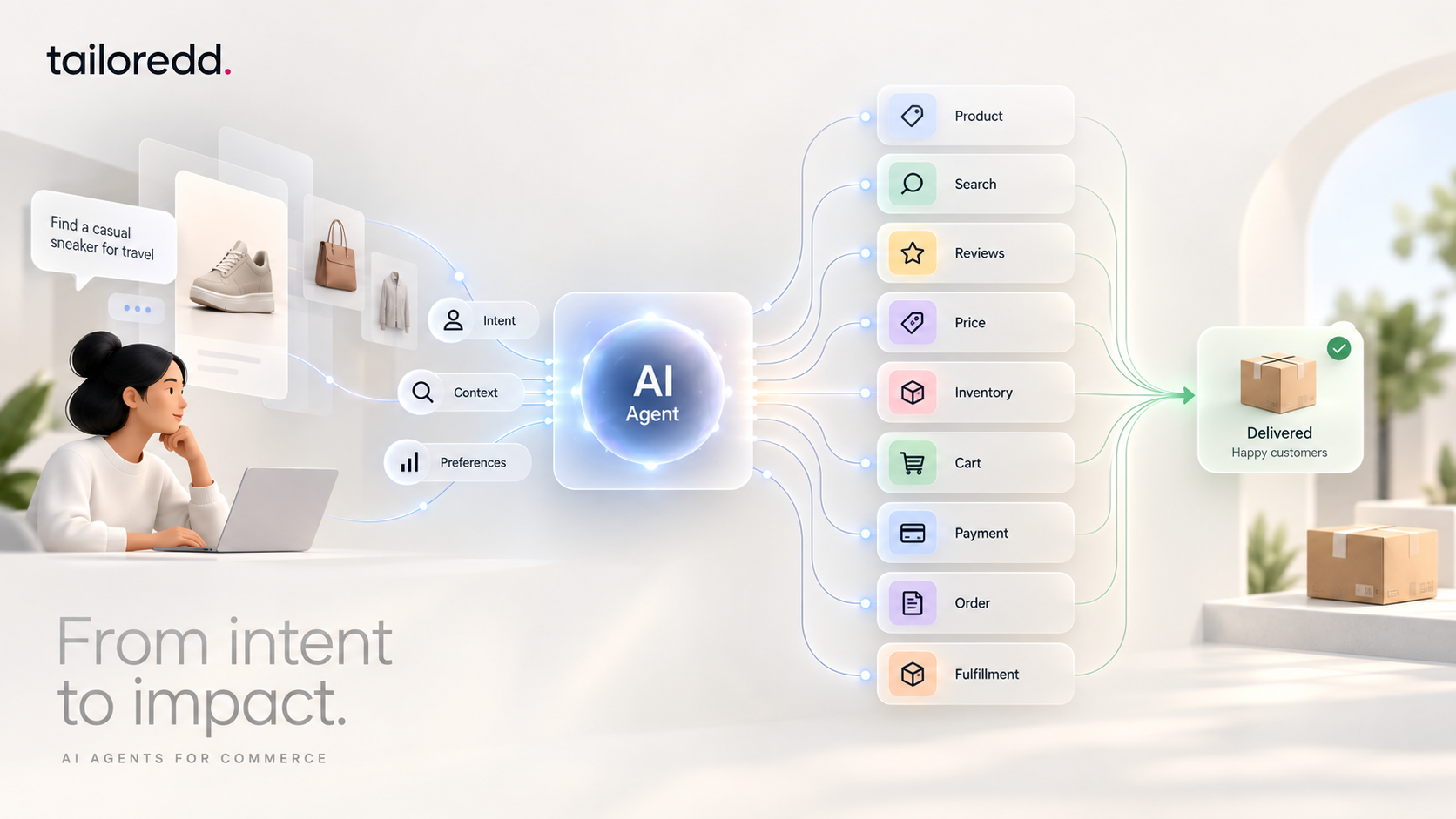
Dreamforce made AI agents look like the next storefront.
But an agent that can talk to a shopper is the easy part. The difficult part begins when it has to understand your catalogue, trust your inventory, compare a product, interpret reviews, apply the right price, place an order and know what happens after checkout.
That is where agentic commerce stops being an AI demo and becomes a commerce architecture problem.
Salesforce has spent much of 2026 making that transition increasingly concrete.
Agentforce Commerce now spans shopper, buyer and merchant use cases across B2C, B2B, point of sale and order management. Salesforce has also integrated Agentic Commerce Search with B2C Commerce and Shopper Agent, pushing product discovery away from literal keyword matching toward interpreting shopper intent.
Dreamforce 2026 widened the picture further. Salesforce announced new job-ready agents capable of working toward longer-running goals, introduced Koa, its CRM reasoning model built on NVIDIA Nemotron, and continued connecting Agentforce with a broader enterprise AI ecosystem.
The demos will naturally focus on what the agent can do.
Commerce teams should pay just as much attention to what the agent depends on.
Your Next Commerce Channel May Not Have a Homepage
For most of ecommerce’s history, architecture started with a fairly stable assumption.
A shopper arrives at a storefront.
Maybe they come through Google, Instagram, email or an app, but eventually the merchant controls the experience. The shopper sees the navigation, product listing page, PDP, cart and checkout that the merchant designed.
Agentic commerce weakens that assumption.
A shopper may increasingly start with an AI interface and ask:
“Find me waterproof walking shoes under ₹8,000 that work for wide feet and can arrive before Friday.”
The interesting part isn’t generating a conversational answer.
The difficult part is resolving everything hidden inside that sentence:
- Which products actually satisfy those characteristics?
- Is size 9 available?
- Which warehouse can fulfill it?
- Is the promised delivery date realistic for this postcode?
- Are there verified reviews mentioning wide-foot fit?
- Does the customer qualify for a promotion?
- What happens if two sellers offer the same SKU?
- Can the agent actually transact, or should it hand the customer into checkout?
Those questions cross systems.
An LLM cannot solve bad product data, stale inventory or contradictory fulfillment rules simply by becoming more intelligent.
The Product Catalogue Becomes an Interface
Humans tolerate surprisingly messy commerce data.
We infer that “navy” and “midnight blue” might be similar. We inspect photographs when attributes are missing. We open another tab when the description isn’t clear.
Software is less forgiving.
If AI agents are going to discover and compare products reliably, catalogue quality becomes part of customer experience architecture.
That means product attributes, taxonomy, identifiers, availability, pricing, media, structured data and product relationships matter beyond the PDP.
This is one reason the movement toward conversational commerce should not be treated purely as a frontend project.
The merchant’s product model increasingly becomes machine-readable merchandising.
Search Is Moving from Keywords Toward Intent
Traditional commerce search has largely been an exercise in matching a query against catalogue terms, supplemented by synonyms, boosting rules, behavioural data and merchandising intervention.
AI-native discovery changes the interaction.
Salesforce says its Agentic Commerce Search interprets natural-language intent and is now integrated into B2C Commerce and Shopper Agent. The company also describes using synthetic shopping journeys alongside merchant catalogue and behavioural data to train retailer-specific discovery models.
There is an important architectural consequence here.
Search, recommendations, conversational shopping and merchandising start becoming less isolated from one another.
A shopper doesn’t care which subsystem answered the question. They care whether the answer is useful.
Commerce teams therefore need to evaluate AI discovery on outcomes rather than on how impressive the conversation sounds:
- Can it find obscure products?
- Can it respect availability?
- Can merchandising teams still influence commercial priorities?
- Can you explain why a product appeared?
- Can it recover when the shopper’s intent is ambiguous?
Those questions belong in a commerce discovery workshop now.
Reviews May Become Machine-Readable Evidence
Reviews have traditionally served two audiences: shoppers and search engines.
Agentic commerce introduces a third: shopping agents.
Imagine two products with nearly identical specifications.
One has hundreds of reviews repeatedly mentioning durability in humid climates. Another has a higher average rating but very little descriptive feedback.
A human shopper can investigate that nuance manually.
A sufficiently capable shopping agent can potentially reason across it, provided the review data is accessible, structured and trustworthy.
That makes UGC architecture more interesting.
The question is no longer simply whether star ratings render nicely on a PDP.
It becomes whether review content carries useful product context, whether verified-purchase status is available, whether variant relationships are preserved, whether structured data is correct and whether external systems can consume the content reliably.
This is one reason we think server-accessible, structured commerce content will become increasingly important as discovery moves beyond the browser. That is why ReviewFlow renders natively server-side within the ISML template rather than injecting via client-side script tags, ensuring rich review attributes and verified buyer data are immediately indexable and consumable.
Note: That last point is our interpretation of the direction of commerce architecture, not a claim that any particular AI platform currently consumes every merchant’s review data this way.
Inventory Becomes a Promise, Not a Field
An agent recommending an unavailable product is irritating.
An agent purchasing an unavailable product is an operational problem.
Once software can participate further down the buying journey, inventory accuracy becomes part of agent trust.
That means available-to-sell inventory, reservations, safety stock, seller inventory, store inventory and fulfillment location cannot be treated as interchangeable numbers.
The agent needs a commerce service capable of answering a much harder question:
Can this specific customer actually buy this specific item under these specific conditions right now?
That is where OMS and inventory services become more important, not less. At checkout, tools like Flo solve the risk and delivery assurance boundary, scoring order risk, validating addresses, and confirming COD eligibility in real time before fulfillment commits.
OMS May Be One of the Biggest Beneficiaries of Agentic Commerce
AI commerce is often discussed as a discovery story.
The harder part starts after the order:
- Where should it be fulfilled?
- Can a shipment be split?
- What happens if stock disappears after authorization?
- Can the customer modify the order?
- Which return rules apply?
- What happens when an item is supplied by a marketplace seller?
- Can an agent answer “Where is my order?” without merely reading a tracking number?
The more commerce becomes conversational, the more customers will expect the conversation to continue after payment.
That puts order state, fulfillment events, returns and exceptions directly into the AI experience. For recurring purchases, platforms like Orderly handle the ongoing lifecycle: subscription self-service, skips, swaps, dunning ladders, and webhook-driven observability across billing cycles.
A capable agent sitting above an opaque OMS is still an opaque customer experience.
Marketplaces Make the Problem Harder Again
A marketplace adds another layer of decision-making.
The product is no longer necessarily the offer.
Three sellers may offer the same item with different inventory, prices, fulfillment promises, commissions and service levels.
The commerce layer must decide which offer wins before an AI agent can confidently recommend anything.
That means buy-box logic, seller status, inventory reservation, fulfillment SLA and settlement rules cannot live as disconnected operational processes if agent-driven discovery is expected to use them.
Architectures like Emporio manage multi-vendor catalog moderation, atomic inventory reservations, and buy-box arbitration so that offers are clean before an agent surfaces them.
Agentic commerce therefore does not eliminate commerce orchestration.
It exposes weak orchestration faster.
Payments Are Moving in the Same Direction
The wider payments industry is also working on mechanisms for agent-mediated transactions. That makes authorization, identity, limits, proof of intent and liability increasingly important questions.
The useful distinction for commerce leaders is between an agent that recommends something and one that is authorized to act.
Those are very different risk models.
A production architecture should define exactly where autonomy stops:
- Discovery may be highly autonomous.
- A high-value transaction may require explicit confirmation.
- A subscription change may have different rules again.
There probably will not be one universal autonomy setting for commerce. For an in-depth operational blueprint covering boundary enforcement, tool schema validation, and audit trail patterns for autonomous tools, read our technical reference on Commerce MCP Agents & Operational Boundaries.
So What Should a Commerce Team Do Now?
You do not need to redesign your entire platform because Dreamforce had impressive AI demos.
You should test whether the foundations are ready.
Start with six questions:
-
Can another system understand our catalogue without looking at the storefront?
If product meaning exists mostly in merchandising copy and images, fix the product model. -
Can we expose accurate price and availability programmatically?
If different channels regularly disagree, an AI agent will inherit the disagreement. -
Can search understand intent rather than only exact terminology?
Test real customer language, not curated demo queries. -
Can product evidence travel with the product?
Reviews, ratings, Q&A, specifications and policies increasingly need to be structured and accessible. -
Can our order layer explain what happened after checkout?
Order status is not enough. Exceptions matter. -
Can every action be bounded and audited?
The more autonomy you give an agent, the more important permissions, observability and fallback paths become.
The Architecture Is Moving from Channels to Capabilities
This may be the most important shift.
For years, commerce architecture diagrams have been organised around channels:
- Web
- Mobile
- Store
- Marketplace
- Social
Agentic commerce suggests another model.
The experience layer may keep changing, but underneath it merchants need stable capabilities:
- Product
- Search
- Price
- Inventory
- Customer
- Promotion
- Review
- Cart
- Payment
- Order
- Fulfillment
- Return
Those capabilities need clear APIs, permissions and event models regardless of whether the caller is a React storefront, mobile application, store associate or AI agent.
That is why the agentic-commerce discussion is ultimately less about replacing the storefront than making commerce capabilities usable without depending on one. Teams planning these architectural transitions can consult our Salesforce Commerce Cloud Guide and review the Tailoredd product suite for native cartridges.
The Storefront Isn’t Disappearing
Human shopping is visual, emotional and exploratory.
People will still browse collections, compare photographs, discover brands and enjoy deliberately designed experiences.
AI agents add another path.
And that path may be particularly powerful when the customer’s intent is already clear.
The architecture question for commerce leaders is therefore not:
“Will AI replace our website?”
A better question is:
“If the next customer arrives through an interface we don’t own, can our commerce stack still understand the request, make the right promise and complete the transaction?”
Dreamforce made the agent visible.
The next phase of commerce work is making everything behind it dependable.
Tailoredd builds commerce products and implementation patterns across reviews and UGC (ReviewFlow), subscriptions (Orderly), COD/RTO (Flo), marketplaces (Emporio) and modern commerce architecture. The architectural observations in this article are our interpretation of where agent-driven commerce is heading; product-specific capabilities and roadmaps should always be validated against the relevant vendor’s current documentation.