Guide
Salesforce Commerce Cloud Guide 2026
A practical guide for teams evaluating SFCC fit, architecture choices, and where growth products plug into the stack.
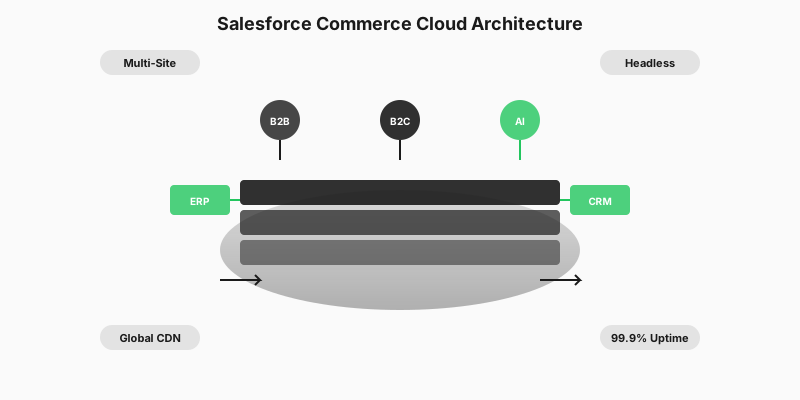
What is Salesforce Commerce Cloud?
Salesforce Commerce Cloud is an enterprise commerce platform built for teams that need more than a basic storefront. It is strongest when customer data, account structure, regional complexity, and ecosystem fit all matter at the same time.
For some brands, SFCC is the right long-term platform because it handles both complexity and scale. For others, it adds cost and operational overhead they do not need. The real question is not whether SFCC is powerful. It is whether it fits the way your business sells.
Once the platform fit is clear, the next question is which products sit on top of it. ReviewFlow supports shopper trust and PDP conversion on SFCC. Orderly supports subscription lifecycle and retention where recurring revenue matters.
Who SFCC fits best
SFCC can work well across both B2B and B2C, but the buying case changes depending on how complex the business model is.
B2B Commerce
- Complex pricing models and contracts
- Account-based selling and hierarchies
- Bulk ordering and procurement workflows
- Quote-to-cash automation
- Channel partner management
B2C Commerce
- Personalized shopping experiences
- Omnichannel fulfillment options
- Social commerce integration
- Loyalty and rewards programs
- Mobile-first design
Key Features & Capabilities
These are the platform capabilities that usually matter most during evaluation, because they affect both stack fit and long-term ownership.
B2B Commerce
Enterprise B2B commerce with complex pricing, account hierarchies, and procurement workflows
B2C Commerce
Consumer-focused commerce with personalized experiences and omnichannel capabilities
Headless Architecture
API-first approach for maximum flexibility and custom frontend experiences
Einstein AI
AI-powered personalization, recommendations, and customer insights
Data Cloud Integration
Unified customer data platform for 360-degree customer view
Multi-Site Management
Manage multiple sites and brands from a single platform
Platform Capabilities
Use these as a quick read on why teams choose SFCC and where product layers like ReviewFlow or Orderly can sit on top without fighting the platform.
What shapes timeline and risk
The hardest part of an SFCC rollout is rarely the platform alone. Risk grows when the team underestimates integration depth, data quality, and ownership after go-live.
Platform fit
Decide whether SFCC actually fits your commercial model before adding custom scope.
Architecture choices
Map native storefront, hybrid headless, and middleware decisions early so the stack stays legible.
Integration scope
ERP, OMS, pricing, customer data, payments, and product add-ons are usually what stretch cost and timeline.
Data and QA
Migration quality, search data, catalog structure, and test coverage decide whether the launch feels stable.
Ownership after launch
Know which team owns merchandising, storefront changes, integrations, and growth products once traffic is live.
Where SFCC tends to fit well
SFCC tends to make more sense in industries where account logic, pricing complexity, or regional scale push the team beyond simpler commerce stacks.
Retail & Fashion
Tailored solutions for retail & fashion commerce challenges
Manufacturing
Tailored solutions for manufacturing commerce challenges
Consumer Goods
Tailored solutions for consumer goods commerce challenges
Wholesale
Tailored solutions for wholesale commerce challenges
Healthcare
Tailored solutions for healthcare commerce challenges
Automotive
Tailored solutions for automotive commerce challenges
Electronics
Tailored solutions for electronics commerce challenges
Beauty
Tailored solutions for beauty commerce challenges
Food & Beverage
Tailored solutions for food & beverage commerce challenges
Frequently Asked Questions
What is Salesforce Commerce Cloud and how does it differ from other platforms?
Salesforce Commerce Cloud is an enterprise commerce platform that sits naturally inside the Salesforce ecosystem. It tends to fit teams that need stronger account logic, global scale, and tighter CRM alignment than lighter storefront platforms usually provide.
How long does a typical Salesforce Commerce Cloud implementation take?
Timelines depend on catalog complexity, integration depth, data migration quality, and how much custom workflow logic the business needs. The platform decision is only one part of the timeline; the operating model matters just as much.
What are the key benefits of migrating to Salesforce Commerce Cloud?
The main advantages are Salesforce ecosystem alignment, stronger B2B and multi-site depth, enterprise scalability, and a platform model that can support both native storefront patterns and more modular architectures.
How much does Salesforce Commerce Cloud implementation cost?
Costs vary widely based on licensing, custom workflow needs, integration depth, and rollout shape. Use the ROI and cost tools on this site for planning ranges, not as a final commercial commitment.
What industries benefit most from Salesforce Commerce Cloud?
SFCC tends to fit brands with more complex account structures, catalog rules, regional needs, or Salesforce ecosystem dependencies. It is especially relevant when B2B and B2C requirements have to coexist in one broader stack.
Planning around SFCC?
Start with the platform fit, then decide which growth products belong on top of it.